
Table of Contents
Moringa (Sitalchini/Saijan): Benefits, Uses, Nutrition and Cultivation in Nepal

Moringa, known in Nepal by names such as Sitalchini and Saijan, is a useful tree that has become increasingly popular because of its nutritional value, traditional uses and agricultural potential. Around the world, people are now interested in moringa benefits, particularly those associated with its leaves, pods and powdered leaves.
In Nepal, however, moringa is not simply a modern health-food product. It is a plant that can connect traditional food, household nutrition and farming. In the past, many people did not know the importance of this tree. It could grow naturally around fields, forests and homes, and some people considered it an ordinary plant rather than something valuable.
As people became more interested in traditional foods, Ayurveda and the nutritional properties of plants, they began paying greater attention to moringa. Today, fresh moringa leaves are cooked as vegetables, young pods are used in different dishes, and dried leaves are made into moringa powder.
There is also increasing interest in the moringa benefits associated with its nutritional composition. Moringa leaves contain protein, minerals, vitamins and various naturally occurring plant compounds. Researchers have also studied the plant for possible antioxidant and metabolic effects.
However, moringa should not be considered a miracle medicine. Some traditional claims about moringa are much stronger than what current human research can establish. It may be a nutritious food and a useful traditional plant, but it should not replace prescribed medicines or professional medical care.
What Is Moringa?
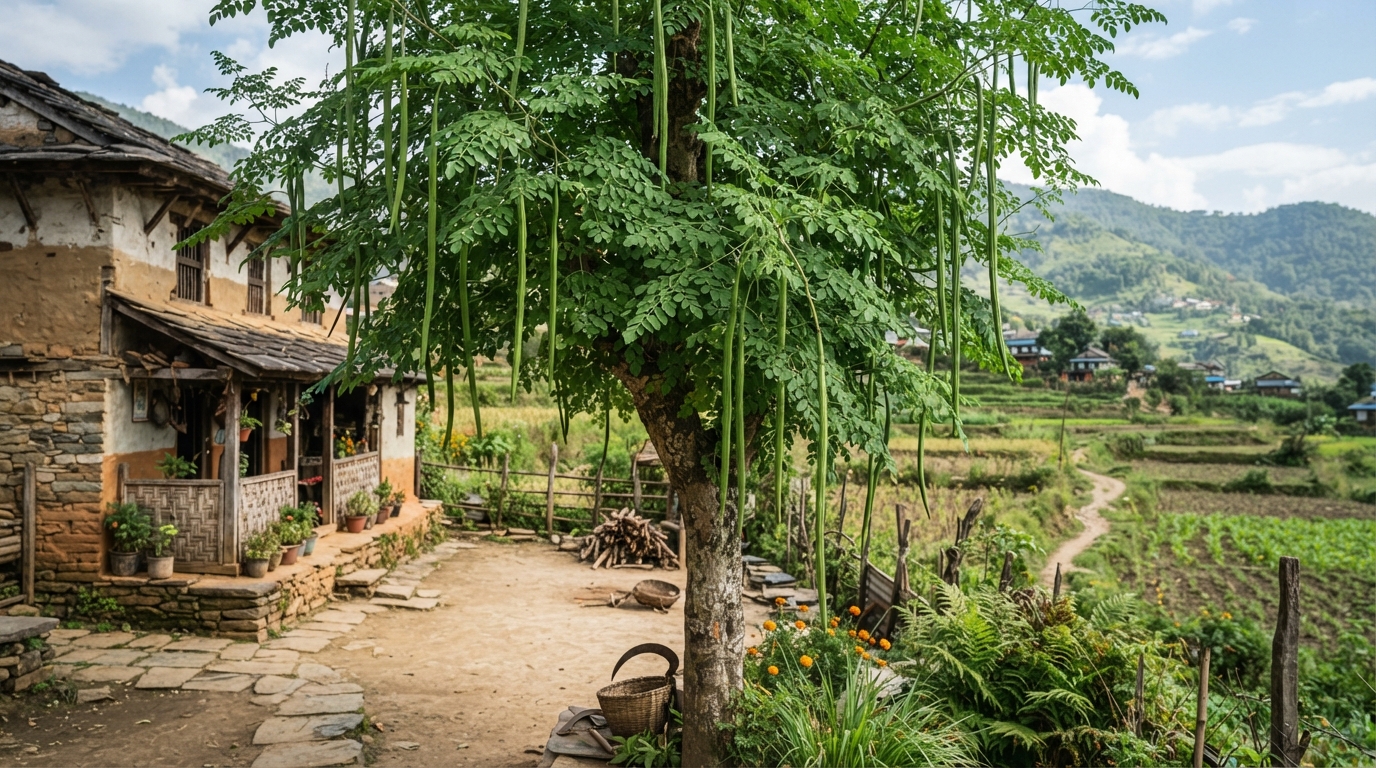
Moringa is a fast-growing tree scientifically known as Moringa oleifera. It belongs to the Moringaceae family and is commonly called the drumstick tree because its long green pods resemble drumsticks.
The tree is grown in many tropical and subtropical parts of the world. Several parts of the plant can be useful, including the leaves, young pods, flowers and mature seeds.
The leaves are particularly popular because they can be eaten fresh or dried. When dried properly, they can be ground into a fine green powder. This powder can then be stored and used in small amounts in food or other preparations.
Young moringa pods can also be cooked as vegetables. Mature seeds can be used to produce oil, while the tree has also been studied for fodder and agricultural applications.
One reason people are interested in moringa benefits is that a single tree can provide several different types of useful products.
Sitalchini and Saijan: Moringa in Nepal
In Nepal, moringa is commonly known by names including Sitalchini and Saijan. Depending on the region and local language, different names may be used.
My mother remembers that people in the past did not always understand the value of this tree. Like many plants growing naturally around rural homes and fields, it could be overlooked.
As knowledge of traditional plants increased, people began recognizing that Sitalchini could be useful as food as well as a household plant.
Today, the interest in moringa benefits is growing beyond traditional use. People are researching its nutritional properties, purchasing moringa powder and growing the tree in home gardens and farms.
This change is particularly interesting for Nepal because moringa can be considered from both the food and agriculture perspectives.
Research has described moringa as an underutilized crop in Nepal and highlighted its potential as a nutritious food and agroforestry tree. Its fast growth and ability to provide several useful products make it an interesting plant for suitable areas.
Moringa Benefits: Why Are Moringa Leaves So Valuable?

The leaves are one of the most important parts of the moringa tree.
When people search for moringa benefits, they are often interested in what the leaves contain. Fresh leaves provide protein, fibre, minerals, vitamins and naturally occurring plant compounds.
Moringa leaves also contain compounds such as flavonoids and phenolic substances that have antioxidant activity. Antioxidants are substances that can help protect cells from oxidative stress.
This does not mean that eating moringa leaves will cure disease. Instead, it means that moringa can contribute useful nutrients and plant compounds to an overall balanced diet.
Moringa Benefits for Everyday Nutrition
One of the practical moringa benefits is that the leaves can be incorporated into ordinary meals.
Fresh leaves can be:
- Cooked as a vegetable
- Added to soups
- Combined with other vegetables
- Cooked with lentils and other foods
- Dried for later use
- Ground into powder
- Used in some traditional tea preparations
This makes moringa different from many products that are sold only as supplements. A moringa tree can provide an actual food ingredient that can be harvested at home.
Moringa Benefits From Antioxidant Plant Compounds
Moringa leaves contain various plant compounds that have demonstrated antioxidant activity in laboratory research.
This is one reason scientists have studied the plant for possible health applications. However, antioxidant activity measured in a laboratory does not automatically mean that eating moringa prevents or cures a particular disease in humans.
It is better to understand this as one part of the nutritional value of the plant.
Moringa Benefits as Part of a Balanced Diet
Another practical advantage is that moringa can add variety to a person’s diet.
A healthy diet does not need to depend on one “superfood.” Instead, different vegetables, fruits, grains, legumes, seeds and other foods can provide different nutrients.
Moringa can be one of those foods.
For families growing their own vegetables, having a tree that produces edible leaves and pods can also provide a convenient source of fresh food.
Moringa Nutrition Facts
When people search for moringa nutrition facts, they often want to know why the leaves have attracted so much attention.
Moringa leaves contain protein, calcium, potassium, iron, fibre and various vitamins and plant compounds. The exact nutritional composition can vary depending on the variety, soil, climate, maturity and whether the leaves are fresh or dried.

Dried leaves are especially concentrated because most of their water has been removed. This is why moringa powder can contain a higher amount of nutrients by weight than fresh leaves.
However, nutritional values found online should not be treated as universal numbers for every moringa product.
The plant’s growing conditions and processing methods matter.
For this reason, it is better to think of moringa benefits in terms of its overall nutritional contribution rather than expecting one serving to provide every nutrient the body needs.
Moringa Leaves and Moringa Powder

Moringa leaves are commonly used fresh, while dried leaves can be ground into powder.
To make leaf powder, mature and healthy leaves should be properly harvested, cleaned and dried under hygienic conditions. Once thoroughly dried, the leaves can be ground and stored in an airtight container away from moisture.
Moringa powder has become popular because it is convenient. People can add a small amount to food, smoothies or other preparations.
However, not every product sold as moringa powder is necessarily of the same quality.
When buying commercial moringa powder, check:
- The ingredient list
- The manufacturer
- The packaging
- The expiry or best-before date
- Storage instructions
- Whether the plant part is clearly identified
- Whether the seller is trustworthy
The growing popularity of moringa benefits has also created a market for commercial powders, capsules and other products. This makes it more important for consumers to understand what they are actually buying.
What Does Moringa Do for the Body?
The question “what does moringa do for the body?” is becoming increasingly common.
The most straightforward answer is that moringa provides nutrients and naturally occurring plant compounds when consumed as food.
Research has investigated moringa for possible effects involving blood glucose, blood lipids, oxidative stress and inflammation. Some studies have produced promising findings, but the strength of evidence varies depending on the health condition, preparation and dose.
This is an important point when discussing moringa benefits.
A result observed in a laboratory or animal study cannot automatically be presented as a proven treatment for people.
Moringa can be nutritious, but claims that it cures diabetes, thyroid problems, high blood pressure, high cholesterol or other diseases should be treated with caution.
Is Moringa Good for Diabetes?
“Is moringa good for diabetes?” is one of the questions people frequently ask about this plant.
Researchers have studied whether moringa leaves and their extracts may influence blood glucose. Some animal studies and small human studies have produced encouraging findings.
However, the evidence is not strong enough to say that moringa cures diabetes.
A person with diabetes should continue following the treatment plan provided by their healthcare professional. If they want to use moringa powder or a concentrated supplement, they should discuss it with their doctor or another qualified healthcare professional.
The potential moringa benefits being studied in relation to blood sugar should therefore not be confused with established diabetes treatment.
Moringa can be part of a nutritious diet, but it is not a replacement for prescribed diabetes medication.
Does Moringa Lose Belly Fat?
Another popular question is, “Does moringa lose belly fat?”
Moringa should not be considered a special fat-burning food.
Losing excess body fat generally requires an overall approach involving diet, physical activity, sleep and energy balance. Adding moringa powder to an otherwise unchanged lifestyle does not guarantee weight loss.
The plant can be included in a balanced diet because its leaves provide nutrients, but there is no reliable evidence that simply drinking moringa will specifically remove belly fat.
The same caution applies to claims about the best time to drink moringa for weight loss.
There is currently no established drinking schedule that makes moringa a special weight-loss treatment.
Some of the online discussion surrounding moringa benefits has become exaggerated because of marketing, so readers should separate nutritional value from unsupported weight-loss promises.
What Happens If You Take Moringa Every Day?
Whether someone can take moringa every day depends on the form and amount being consumed.
Eating moringa leaves as part of normal meals is different from taking concentrated extracts or large quantities of supplements.
Some studies have investigated daily use of moringa leaf preparations, but long-term human evidence remains limited. Different products can also contain different concentrations of plant compounds.
Therefore, more is not necessarily better.
If you enjoy moringa as a vegetable or use a modest amount of a reputable leaf powder as part of your diet, it should still be viewed as one food rather than a complete health treatment.
What Is the Best Way to Take Moringa?
There is no single best way to take moringa for everyone.
For ordinary food use, fresh leaves can be cooked as vegetables or added to soup. Dried leaves can be made into powder and used in small amounts.
Moringa tea is another preparation.
Commercial products also include capsules and other supplements. These products may contain more concentrated amounts than ordinary food, so they deserve greater caution.
For general nutrition, using moringa as a food is a straightforward approach.
People should follow the instructions on reputable commercial products rather than assuming that taking a larger amount will produce greater moringa benefits.
Moringa Tea Benefits
Moringa leaves can be dried and used to prepare tea.
For many people, moringa tea is simply another way of consuming the plant. It may provide some water-soluble plant compounds, but it is not nutritionally identical to eating the whole leaves.
There are many claims online about moringa tea benefits, including claims about detoxification, rapid weight loss and treatment of chronic diseases.
Such claims should be approached carefully.
Drinking moringa tea can be part of a varied diet, but it should not be presented as a replacement for medical treatment.
Is Moringa Safe for Kidneys?
People also ask whether moringa is safe for the kidneys.
This question is difficult to answer with one simple statement because research has examined different plant parts, extracts and doses.
Some experimental research has investigated possible protective effects, while other studies highlight the importance of dosage and preparation.
There is not enough long-term human evidence to recommend concentrated moringa supplements as a treatment for kidney disease.
Anyone with kidney disease should speak with a healthcare professional before using concentrated herbal supplements.
This is particularly important for people taking prescription medicines.
What Are the Bad Side Effects of Moringa?
Moringa is a natural plant, but being natural does not automatically mean that every preparation is risk-free.
Common food use of moringa leaves is different from taking concentrated extracts, capsules or large quantities of powdered products.
Potential concerns include poor-quality products, contamination, incorrect plant identification and interactions with medicines.
Different parts of the moringa tree may also have different chemical compositions. For this reason, people should not assume that the roots, bark, seeds, leaves and extracts are interchangeable.
Pregnant or breastfeeding women, people with chronic diseases and those taking prescription medicines should be especially cautious with concentrated supplements.
The safest approach is to treat moringa as a nutritious food and seek professional advice before using concentrated products for a medical purpose.
Who Cannot Take Moringa?
There is no simple list saying that one group of people can never consume any form of moringa.
However, some people should be particularly careful with concentrated moringa products.
These include people who:
- Are pregnant or breastfeeding
- Take regular prescription medicines
- Take medication for diabetes
- Have kidney disease
- Have liver disease
- Have another chronic health condition
- Are considering high-dose supplements
This does not mean that ordinary food portions are automatically unsafe.
It means that supplements and concentrated extracts require more caution because their dose and composition can differ substantially from normal food.
Moringa Tree and Its Different Parts
One of the most interesting characteristics of the moringa tree is that different parts can be used in different ways.
Moringa Leaves
The leaves are widely used as food. They can be cooked fresh, dried or made into powder.

Moringa Pods
Young green pods are commonly cooked as vegetables. Their long shape explains the name “drumstick tree.”
Moringa Flowers
The flowers are also used as food in some traditional cuisines.
Moringa Seeds
Mature seeds can be used to produce moringa oil, sometimes known as ben oil.
Moringa Oil
Moringa oil is produced from the seeds and has applications in food, cosmetics and other products.
Because each plant part has different properties, it is important not to assume that information about moringa leaves automatically applies to roots, bark or concentrated extracts.
How to Use Moringa Leaves

There are many simple ways to use moringa leaves as food.
Fresh leaves can be:
- Cooked as a vegetable
- Added to soup
- Mixed with lentils
- Combined with other vegetables
- Dried for storage
- Ground into powder
- Used to make tea
In Nepalese households, locally available leafy vegetables have traditionally been an important part of meals. Moringa can fit naturally into this food culture.
The value of moringa benefits is therefore not limited to capsules or powders sold in shops. The leaves can simply become another nutritious ingredient in everyday cooking.
Moringa Cultivation in Nepal
Moringa also has an important agricultural side. For Nepalese farmers, Sitalchini can be interesting because the tree can provide several products from the same plant.

Depending on the variety and growing conditions, farmers can harvest leaves and pods, while mature trees can also provide seeds.
Moringa is generally associated with warm climates, and its growth depends on temperature, water, soil and local conditions.
It is therefore important for farmers to choose suitable locations rather than assuming that the tree will grow equally well everywhere in Nepal.
One reason for the growing agricultural interest in moringa benefits is that the plant can potentially connect nutrition with farm income.
Growing Moringa From Seeds or Cuttings

Moringa can be propagated through seeds or stem cuttings.
Seeds may be started in a nursery or planted directly under appropriate conditions. Healthy cuttings can also be used for propagation.
Farmers should choose a method according to their production goals.
If the main goal is leafy production, pruning and management can encourage new shoots. If pods are the main goal, spacing and tree management may be different.
Young plants should be monitored for pests, disease and waterlogging.
Moringa is often described as an easy tree to grow, but “easy” does not mean that it requires no care. Good planting material, appropriate soil, water management and regular observation are still important.
Why Moringa Can Be an Interesting Crop for Farmers
Moringa can provide several useful products from a relatively small area.
A farmer may be able to produce:
- Fresh leaves
- Young pods
- Dried leaves
- Moringa powder
- Seeds
- Moringa oil
- Potential fodder
This diversity can make the tree attractive to smallholder farmers.
However, it is important not to promise that every moringa farmer will automatically earn a large income.
Profit depends on production costs, local demand, processing, transportation, quality and access to buyers.
The real agricultural opportunity is created when farmers understand both production and the market.
Moringa as a Source of Additional Farm Income
Moringa powder has become increasingly popular in health-food markets.
Farmers who produce clean, good-quality leaves may potentially add value by drying and processing them rather than selling everything fresh.
However, processing requires proper hygiene.

Leaves must be correctly identified, cleaned, dried and stored. Powder should be protected from moisture and contamination. If it is sold commercially, appropriate packaging and labelling are also important.
Farmers should therefore investigate the market before making a large investment.
It is useful to ask:
- Who will buy the product?
- Is there demand for fresh leaves?
- Is there a market for pods?
- Is there demand for powder?
- What quality standards do buyers expect?
- How will the product be processed?
- How will it be packaged and transported?
These questions are more important than simply assuming that the popularity of moringa benefits online will automatically create a profitable market.
Why Quality Matters When Buying Moringa Powder
As moringa becomes more popular, more products are appearing in shops and online marketplaces.
Consumers should not choose a product only because its package contains impressive health claims.
A trustworthy product should clearly state:
- Ingredients
- Manufacturer or producer
- Expiry or best-before date
- Storage instructions
- Product weight
- Plant part used
- Relevant quality information
Consumers should also be cautious of products claiming to cure many unrelated diseases or replace prescribed medicines.
Moringa powder should be treated as a food or supplement rather than a miracle cure.
Is Moringa a Miracle Tree?
Moringa is sometimes called a miracle tree because of the number of ways it can be used.
There is some reason for this reputation.
One tree can provide edible leaves, young pods, flowers, seeds and oil. The leaves contain several important nutrients and plant compounds. The tree can also be useful as fodder and has agricultural potential.
However, calling it a miracle tree should not mean believing that moringa can cure every illness.
The more realistic moringa benefits are found in its combination of nutritional, culinary and agricultural uses.
It can be food.
It can be a household tree.
It can be a source of leaves and pods.
It can provide raw material for powder and oil.
And under suitable conditions, it can become an additional crop for farmers.
That is already a significant collection of benefits without making unsupported medical promises.
Moringa, Traditional Knowledge and Modern Research
There is an important connection between traditional knowledge and modern research.
People have used plants for generations based on observation and experience. Modern science can then investigate the nutrients and compounds present in those plants.
Moringa is an example of this process.
Traditional communities recognized useful characteristics of the tree long before modern research became interested in its nutritional composition.
Today, researchers are studying the plant in laboratories, animals and human trials.
Some results are promising, but not every traditional claim has been confirmed by high-quality human research.
This is why we should appreciate traditional knowledge while also understanding the limits of scientific evidence.
The growing interest in moringa benefits should encourage better research and better use of the plant, rather than exaggerated claims.
Final Thoughts on Moringa, Sitalchini and Saijan
Moringa, known in Nepal as Sitalchini or Saijan, is more than a fashionable green powder.
It is a multipurpose tree with nutritional, culinary and agricultural value.
Its leaves can be cooked as vegetables, dried and made into powder, or used in traditional preparations. Its young pods can be eaten as vegetables, while its mature seeds can provide oil.
For farmers, the tree can offer another possible source of food and income when it is grown under suitable conditions and connected to a reliable market.
For households, a few healthy trees may provide fresh leaves and pods without requiring a large area of farmland.
The scientific interest in moringa benefits is also understandable because the leaves contain protein, minerals, vitamins and various plant compounds. Researchers continue to investigate possible effects related to antioxidant activity, blood glucose, blood lipids and other areas.
At the same time, it is important to remain realistic.
Moringa should not be described as a cure for diabetes, high blood pressure, thyroid disease, kidney disease or other medical conditions. It should not replace prescribed medicines.
The best way to understand Sitalchini is perhaps to look at the whole plant rather than one health claim.
Moringa is a nutritious food, a useful tree, a traditional ingredient and a potentially valuable agricultural crop.
For Nepal, where farmers and households have long relied on locally available plants, learning more about this tree may help us make better use of something that has been growing around us for generations.
Rather than searching only for a miracle cure, we can appreciate moringa benefits for what they realistically offer: nutritious leaves, useful pods, traditional food, agricultural possibilities and an opportunity to bring greater value to a locally grown plant.
When used wisely and as part of a balanced diet, Sitalchini or Saijan can be an interesting addition to Nepalese food and farming.


